Who is Liable in a Truck Accident? Key Takeaways
- Liability in an Arizona truck accident can fall on the driver, the trucking company, or several parties at once, depending on the specific circumstances of the crash.
- Arizona uses a “comparative negligence” system under A.R.S. § 12-2506, meaning fault and financial responsibility can be divided among multiple people and businesses involved.
- Trucking companies are often responsible for their drivers’ negligence under “vicarious liability” and may also be directly liable for unsafe hiring, training, or maintenance practices.
- Truck accident claims are often more complex than car accident claims due to the involvement of multiple parties and federal regulations.
- Evidence can disappear quickly in commercial trucking cases—electronic logs, vehicle data, and employment files may be altered or erased within days.
- Liability in truck accidents is typically proven using objective data from FMCSA-regulated records, such as black box data and electronic logging devices (ELDs).
- If you’ve been injured in a truck crash in Arizona, contact the JacksonWhite personal injury team for a consultation.
How Liability Works in an Arizona Truck Accident
“Liability” means who is legally responsible for paying damages after a crash occurred. Arizona law focuses on whose negligence contributed to the collision. Drivers are required to stop immediately and report the accident to authorities and their employer.
Negligence is simply failing to use reasonable care—speeding, ignoring hours-of-service limits, or cutting corners on maintenance. In real-world wrecks, more than one party is often at fault: the person or business whose negligence contributed to the crash, such as the truck driver, the trucking company, a broker, or a maintenance contractor.
When the Truck Driver Is Responsible
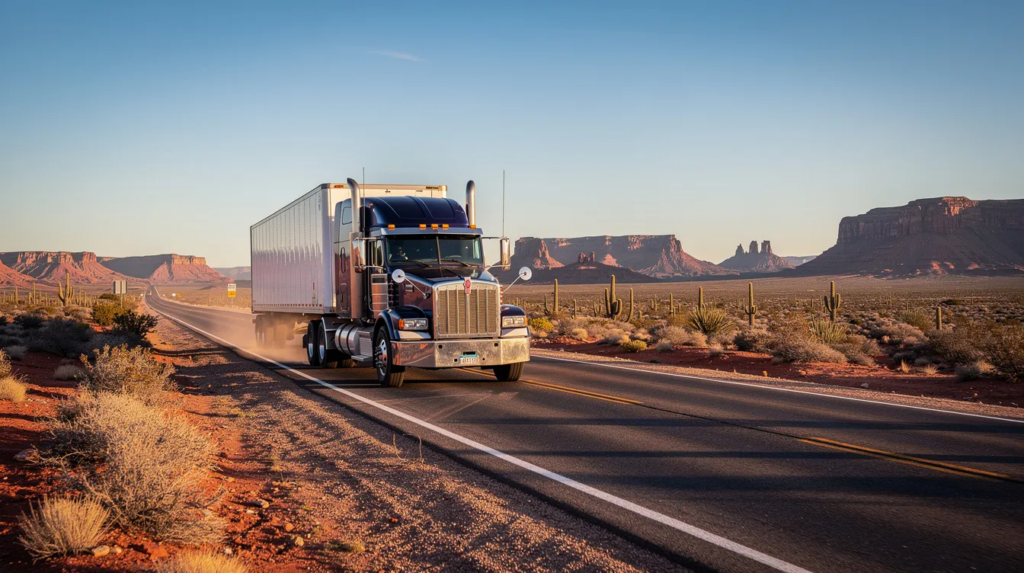
In many Arizona cases, the truck driver is the most obvious at-fault party because they directly control the vehicle at the time of the crash. Truck drivers have legal responsibilities to adhere to traffic laws and regulations to ensure public safety.
Common forms of driver negligence include: speeding, following too closely, distracted driving via cell phone use, aggressive lane changes, making illegal U-turns, fatigue from hours-of-service violations, and DUI. Drivers with a commercial driver’s license face stricter BAC limits (0.04%) under A.R.S. § 28-1381. Truck drivers must also undergo drug and alcohol testing if the accident involved a fatality or if they received a citation.
Violations of federal safety rules strongly support a finding of fault. However, even when a driver is clearly at fault, the trucking company’s insurance company may argue other causes like weather or the victim’s driving.
When the Trucking Company Is Responsible
Trucking companies often share responsibility with their drivers because they control hiring, training, scheduling, and equipment. A company based in Phoenix can be liable for a crash anywhere in Arizona if it cut corners.
Companies can be directly negligent through: hiring drivers with bad records or failed CDL tests, ignoring positive drug tests, failing to train on monsoon conditions, pressuring drivers to violate hours-of-service limits, or skipping brake and tire inspections.
The U.S. Transportation Department has tightened CDL requirements for noncitizens following fatal crashes involving immigrant truck drivers. Various government departments, such as state Departments of Motor Vehicles and the U.S. Department of Transportation, are involved in the issuance and verification of commercial driver’s licenses. FMCSA data shows faulty brakes are implicated in 30% of truck crash inspections. If a company’s hiring or oversight failures contribute to criminal acts by drivers, the company may face multiple counts of liability in addition to civil penalties.
Proving company fault requires internal documents—safety policies, dispatch records, disciplinary files—which an attorney can obtain through discovery.
Vicarious Liability: When the Company Is Responsible for the Driver’s Mistakes
Vicarious liability means an employer can be held responsible for harm caused by its employee while doing their job. Under Arizona law, if you’re hit by a semi truck whose driver was on duty or making a delivery, the trucking company is generally liable.
This is different from direct company fault—the company can be responsible either because of its own bad policies or simply because it employed the negligent driver.
Example: In a 2025 nighttime rear-end collision on I-10 near Casa Grande, a drowsy trucker crashes into stopped traffic. Both the driver and employer can be named in the claim.
From the victim’s perspective, vicarious liability is critical because commercial insurance policies typically have limits of $750,000 to $1 million—far exceeding personal coverage.
Independent Contractors and Leased Drivers
Trucking companies frequently label drivers as “independent contractors” or lease trucks through separate entities, then argue they’re not responsible when a wreck occurs.
Arizona and federal courts look at the real level of control—dispatch instructions, scheduling, required routes, branding on the truck—not just the contract label. Under 49 C.F.R. § 390.5, motor carriers remain responsible for vehicles operating under their USDOT number, even with leased trucks.
Don’t assume you can only pursue the individual driver because paperwork calls them an “independent contractor.” An attorney will examine contracts and pay records to determine true liability.
Other Potentially Responsible Parties in a Truck Accident
In serious Arizona semi crashes, several parties beyond the driver and employer may share liability:
- Shippers and brokers who insisted on unrealistic deadlines or improperly loaded cargo
- Maintenance contractors responsible for faulty repairs like improper brake service
- Manufacturers liable for defects in the truck, trailer, or tires under products liability law
Identifying all responsible parties early helps maximize available insurance coverage and protects against settling for less than full value.
Comparative Negligence and Shared Fault in Arizona
Arizona uses a “pure comparative negligence” system, allowing injured people to recover damages even if partly at fault—though compensation is reduced by their percentage of responsibility. The allocation of fault in truck accidents can have a profound impact on the lives of those involved, affecting not only financial recovery but also the long-term well-being of victims and their families.
Example: If a jury finds a truck driver 80% responsible and an injured motorist 20% responsible for a crash near Mesa with $500,000 in damages, the motorist could recover $400,000.
Insurance companies often try to exaggerate the victim’s role to reduce payouts. Documenting the accident scene and working with counsel is crucial to counter this.
Evidence That Helps Prove Who Is Responsible
Truck accident liability hinges on technical proof, much of which the trucking company controls and can alter or lose quickly.
Key evidence includes:
- Police report and eyewitness statements – Filing the claim as soon after the accident as you can helps ensure your account and those of any witnesses are as accurate as possible.
- Dashcam and traffic camera video – Including photos and videos from the scene can help document the evidence for your claim.
- Scene photographs and skid marks – Be sure to document property damage to vehicles and any other property at the scene. You can submit the police report to the insurance company in addition to photos, videos, and witness statements.
- Electronic data: black boxes, GPS records, ELD logs showing hours-of-service compliance – Electronic Logging Devices are used to detect hours of service violations and driver fatigue, and data from the truck’s black box and ELDs provide objective proof regarding driving behavior, such as speed, braking patterns, and engine performance just before a crash. Companies are responsible for preserving driver logs, maintenance records, and electronic data recorder (EDR) information post-accident, and must maintain a register of all DOT-recordable crashes for at least three years.
- Employment documents: driver qualification files, drug test results, dispatch messages
All claims and supporting documents should be filed promptly with the insurance company to preserve your rights.
JacksonWhite can send preservation letters to carriers immediately to prevent destruction of evidence. Gathering witness statements and personal accounts promptly is crucial to ensure the accuracy and strength of your claim.
How an Arizona Truck Accident Lawyer Evaluates Responsibility
An experienced attorney does more than file paperwork—they strategically investigate to identify every party who may owe compensation.
The investigation into truck accidents often takes longer due to the need to assess commercial vehicle regulations and compliance.
Typical steps include: interviewing the client, obtaining police and ADOT reports, visiting the scene, and securing vehicle inspections. The legal team reviews federal and state regulatory compliance, including hours-of-service logs and maintenance records.
An experienced claims adjuster will be assigned to investigate and examine the evidence after a truck accident.
Attorneys often consult accident reconstructionists and trucking safety experts to explain fault to insurers or juries. Local familiarity with Maricopa, Pima, and Pinal county courts matters when facing national carriers.
Insurance providers will evaluate all contributing factors to the accident and review damages in relation to relevant coverages.
What to Do After a Truck Accident If You’re Unsure Who Is at Fault
It’s normal not to know immediately whether the driver, company, or someone else is to blame—especially after serious injuries or a multi-vehicle collision. The truck accident claims process is multifaceted, and mistakes may happen, but being proactive can help make things easier.
Prioritize emergency medical care first. Then: report the crash to police, notify your own insurance company, and avoid giving detailed recorded statements to the trucking company’s insurer without legal guidance. It’s important to gather information from other drivers, passengers, and witnesses at the scene to ensure all parties involved are accounted for. If the truck driver is undocumented, Immigration and Customs Enforcement (ICE) may become involved in the investigation.
Gather what you can: photos of the accident scene and other vehicles, witness contact information, and copies of medical records. Keep all paperwork related to the crash, including tow bills and missed work documentation. The claims process for truck accidents typically requires more detailed evidence collection compared to car accidents, and the involvement of trucking companies and their insurance providers adds layers of complexity. You should file your claim with your insurance company as soon as possible after the accident.
Contact JacksonWhite promptly so investigation can begin before critical evidence is lost. Due to the complexity of truck accident claims, legal representation may be required more often than in car accident claims.
FAQ: Responsibility in Arizona Truck Accidents
Can both the truck driver and the trucking company be sued at the same time?
Yes. In Arizona, it’s common to name both as defendants when the driver was on duty. The court can divide fault between them, and both parties’ insurance may contribute to compensation.
What if the truck driver was arrested or cited after the crash—does that automatically prove liability?
A citation or arrest for DUI or reckless driving is powerful evidence but doesn’t automatically guarantee a civil win. Your truck accident claim still requires proof of negligence and damages through the full claims process.
Does it matter if the trucking company is based outside Arizona?
No. An out-of-state carrier can be held responsible in Arizona courts if the crash occurred here or the company does business here. JacksonWhite regularly handles claims against national and regional trucking firms from California, Pennsylvania, Ontario, and across the country.
Who pays if the truck driver was underinsured or has no personal assets?
Most commercial trucking operations carry substantial liability insurance. Claims are usually paid by insurers and other responsible businesses, not just the individual driver.
How long do I have to bring a truck accident claim in Arizona?
The general deadline is two years from the date of the crash under A.R.S. § 12-542. However, claims involving government entities have shorter deadlines (180 days for notice). Contact JacksonWhite promptly to protect your rights.
When to Contact JacksonWhite About a Truck Accident Claim
Timing matters in the truck accident claims process. Arizona’s statutes of limitation restrict how long victims have to bring claims, and key evidence can be lost within days of a wreck.
Anyone seriously injured in a collision with a semi-truck or other commercial vehicle in Arizona should speak with a lawyer as soon as they’re medically stable—even if the driver already admitted fault at the scene.
JacksonWhite’s personal injury team can handle communications with insurance carriers, preserve evidence, and help you understand how driver, company, and other-party liability will affect potential compensation. An initial consultation can address questions like “Who is more likely responsible in my situation?” and “How will comparative fault affect my recovery?”
Contact JacksonWhite Attorneys at Law at (480) 485-4482 to schedule a consultation about your Arizona truck accident case.