Key Takeaways
- Arizona generally allows both concealed and open carry for most adults, including permitless carry for those 21 and older, but state law and federal law create strict prohibited zones where firearms are banned.
- Firearms are generally prohibited in K–12 schools and within school zones, most federal buildings (courthouses, post offices, VA facilities), certain government offices, jails, and many ticketed or controlled-access events.
- Some states restrict carrying firearms in certain types of private property where conflict may be likely, such as bars or polling places. Private property owners and businesses in Arizona can lawfully bar firearms through posted signage, and ignoring a “no guns” sign can lead to trespassing charges and potentially additional weapon charges.
- Penalties range from misdemeanor to felony charges depending on the location—violations at federal facilities or in school zones can result in federal prosecution, imprisonment, and permanent loss of gun rights.
- Anyone facing a weapons-related investigation or charge in Arizona should contact the JacksonWhite criminal defense team for a case-specific consultation.
Arizona Gun Carry Basics: When Is It Legal to Carry a Gun?
Arizona operates under a “constitutional carry” framework, making it one of the most permissive states in the nation for lawful carrying of firearms. Under A.R.S. § 13-3102 and related statutes, most adults aged 21 and older may carry concealed without a permit, provided they are not otherwise prohibited from possessing firearms. Adults aged 18 to 20 may generally open carry a loaded firearm in many public places, though with important exceptions discussed throughout this article.
Despite Arizona’s permitless system, the state continues to issue concealed carry permits (often called CCW permits or Concealed Weapons Permits) for those who want them. The Second Amendment does not stop at the state line, but states can set their own reasonable conditions on concealed carry. A valid permit offers benefits such as interstate reciprocity with other states that recognize Arizona licenses, faster firearm purchases, and certain federal exemptions. Some license holders also appreciate the firearm safety training that comes with the permit application process.
Where carry is usually lawful in Arizona:0555
- Most public streets, sidewalks, and common areas
- Public parks (unless otherwise posted or restricted by local ordinance)
- Many businesses and restaurants that do not prohibit firearms by sign or policy
- Your own vehicle, with specific rules for storage in certain locations
It’s critical to understand that being legally allowed to own a gun is different from being legally allowed to carry it everywhere. Prohibited possessors—such as those with felony convictions, domestic violence misdemeanors, or active protective orders under A.R.S. § 13-3101—cannot lawfully possess or carry guns at all, regardless of location.
Many states prohibit concealed carry in educational institutions, government buildings, polling places, courts, medical facilities, places of worship, public transit, and bars or restaurants serving alcohol. The definitions of sensitive places differ greatly between pro-gun-rights states and restricted states. The remainder of this article focuses on “sensitive locations” in Arizona where guns are restricted or completely banned, even for otherwise lawful gun owners.
Schools and School Grounds in Arizona
Both Arizona law and federal law heavily restrict carrying firearms at K–12 schools, making this one of the most serious areas for accidental violations. Parents, staff, and visitors who regularly carry should pay close attention to these rules.
Arizona’s School Restriction
Under A.R.S. § 13-3102(A)(12), firearms are generally prohibited on the grounds of any public, private, or parochial school (K–12) in Arizona. This includes:
- School buildings and classrooms
- Athletic fields and playgrounds
- Parking lots and driveways
- School buses
Violations can result in “misconduct involving weapons” charges, which may be classified as a class 4 felony punishable by 1.5 to 3 years imprisonment.
Limited Arizona Exceptions
Arizona provides narrow statutory exceptions for:
- Firearms locked, unloaded, and stored out of sight in a vehicle under specific conditions
- Law enforcement officers performing official duties
- School-approved programs such as certain ROTC activities or hunter-safety events with written authorization
These exceptions should be treated cautiously—misinterpreting them can lead to serious charges.
The Federal Gun-Free School Zones Act
The federal Gun-Free School Zones Act prohibits carrying firearms within 1,000 feet of a school, with exceptions for state-issued concealed carry permits. Federal exceptions exist for:
- Possession on private property not part of school grounds
- Certain concealed carry permit holders (though the permit must be issued by the state where the school is located)
- Unloaded firearms in locked containers
Carrying near schools in Arizona while relying on another state’s permit can still create legal risk under federal law, even if Arizona’s permitless rules would otherwise apply.
Penalties and Consequences
Violations can trigger both Arizona “misconduct involving weapons” charges and separate federal charges under the Gun-Free School Zones Act. Collateral consequences include loss of gun rights, probation, and potential jail time. Data from the Arizona Department of Public Safety shows over 150 school zone arrests annually from 2020–2025, predominantly involving inadvertent entries by parents during student drop-offs.
Case law such as State v. Brunson (2018) upheld convictions for a parent carrying a concealed firearm near a Phoenix elementary school, emphasizing the 300-foot buffer’s strict enforcement even on adjacent public sidewalks.
Do not assume that school parking lots or quick drop-offs are safe zones for gun carry. If you are charged or investigated for a firearm near a school, seek legal advice from JacksonWhite immediately.

Federal Buildings and Federal Property in Arizona
Federal law overrides Arizona law on federal property. Even a valid Arizona concealed carry permit does not authorize carry in most federal facilities. Understanding these restrictions is essential for anyone who legally carries and visits government offices, courthouses, or federal agencies.
18 U.S.C. § 930: The Federal Facilities Ban
Under 18 U.S.C. § 930, firearms and other dangerous weapons are prohibited in federal facilities—defined as buildings or portions thereof owned or leased by the federal government where federal employees are regularly present to perform official duties. Exceptions are extremely narrow, generally limited to law enforcement, military personnel, and certain authorized federal employees.
Common federal properties in Arizona where firearms are usually illegal:
- U.S. District Courts
- Federal Agency Offices
- VA Medical Centers
- Federal Administrative Buildings
- Probation and Parole Offices
Post Offices and Postal Property
Post offices and postal property are especially strict. USPS regulations and federal case law generally prohibit guns on postal premises, including the interior of the building and often associated parking lots, whether you are carrying open or concealed. Cases like U.S. v. Dorosan (2010) have resulted in convictions for concealed carriers who entered federal buildings despite state-level legality.
Notice Requirements
Federal law requires conspicuous posting of notices at public entrances to federal facilities under 18 U.S.C. § 930(h). Lack of posted notice can be a significant legal issue in a criminal case—but readers should not rely on this as a defense strategy without consulting counsel.
National Parks and Federal Recreation Lands
National parks and national forests in Arizona follow state carry law for general possession under the Credit Card Accountability Responsibility and Disclosure Act amendments of 2009 (18 U.S.C. § 926A). This means you may legally carry in outdoor areas of places like Saguaro National Park or Grand Canyon National Park if compliant with Arizona law.
However, federal rules still restrict guns in certain federal buildings within parks:
- Visitor centers
- Ranger stations
- Administrative offices with posted signs
- Restrooms in federal structures
- Caves and enclosed natural formations with federal oversight
Consequences of Federal Violations
Violations on federal property can lead to federal charges, permanent firearm disqualification, and imprisonment. A federal facility incident involving a firearm—even an unintentional one—can result in misdemeanor charges carrying up to one year in jail and fines up to $100,000. Anyone under investigation for carrying in a federal building should contact JacksonWhite immediately.
Arizona Government Buildings, Courts, and Law Enforcement Facilities
Arizona state law creates its own set of restrictions for government premises under A.R.S. § 13-3102, separate from federal rules. Even otherwise lawful carriers must understand where state law prohibits firearms.
Government Building Restrictions
Many Arizona government buildings prohibit guns and must provide secure storage (such as weapon lockers at entrance security) if they bar weapons. This applies to:
- State office buildings
- County administrative complexes
- City halls
- Arizona State Capitol complex offices in Phoenix
Visitors are often required to check in weapons at security checkpoints before entering.
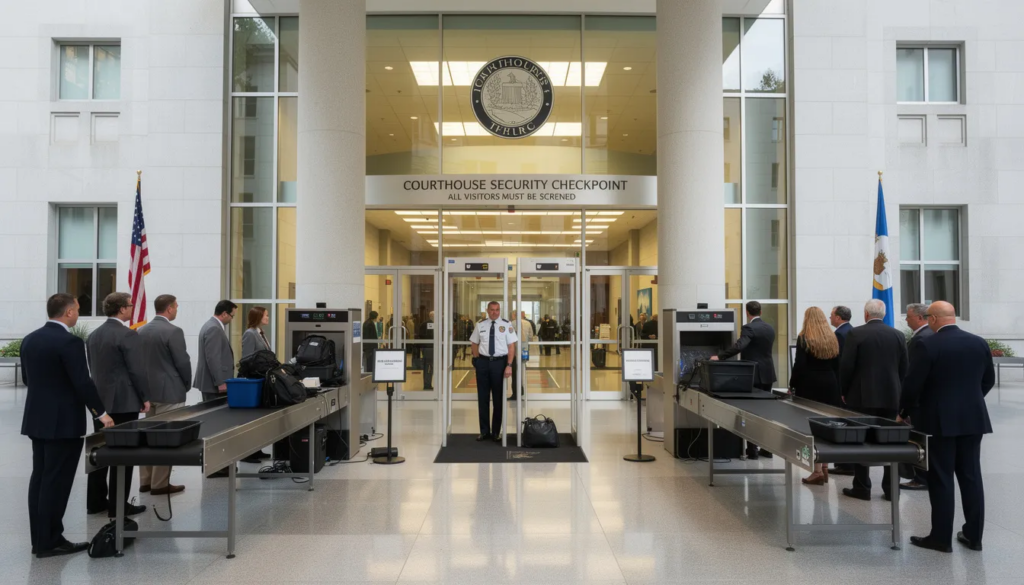
Courthouse Restrictions
Arizona superior court, justice court, and municipal court buildings typically ban firearms beyond security checkpoints. Some courthouses have blanket bans throughout the entire building, regardless of whether you hold a concealed carry permit.
Law Enforcement Facilities
Police stations, sheriff’s offices, and Arizona DPS offices commonly restrict firearms, especially in:
- Secure areas
- Holding cells
- Interview rooms
- Evidence facilities
Exceptions exist for on-duty police officers and retired law enforcement officers with proper credentials, but even these exceptions have limits.
Consequences for Violations
Ignoring posted “no weapons” signs in government buildings and attempting to bring a firearm past security screening can result in arrest for misconduct involving weapons and possibly additional charges such as interfering with judicial or law enforcement operations.
Rules may vary between state, county, and municipal buildings—some spaces allow checked storage while others have absolute bans with no storage available. Always check local policies before carrying.
When someone is charged for bringing a gun into a restricted government building, defenses can turn on details like signage, intent, and whether secure storage was offered—issues that JacksonWhite’s criminal defense team can analyze on a case-by-case basis.
Events, Public Gatherings, and Private Businesses in Arizona
Arizona law recognizes the ability of both public and private event organizers to restrict firearms, particularly when admission is controlled or alcohol is served.
Public Events and Venues
Under A.R.S. § 13-3102, ticketed sporting events, concerts, festivals, and fairs can require patrons to pass through security and bar firearms in the venue. Major Arizona venues with strict firearm policies include:
- State Farm Stadium in Glendale (NFL games, major concerts)
- Footprint Center in Phoenix (NBA games, concerts)
- Chase Field (MLB games)
- Large city-sponsored festivals throughout the Phoenix metro area
At the 2023 Maricopa County Fair, 12 arrests occurred for concealed carry defiance, demonstrating active enforcement at public gatherings.
Private Property Rights
Arizona allows private property owners—including bars, restaurants, theaters, casinos, large venues, and shopping malls—to prohibit firearms through posted signs, employee policies, or conditions of entry.
When a property owner posts a conspicuous “no firearms” sign or provides actual notice, a person carrying must remove the weapon from the premises. Refusal can lead to:
- Criminal trespass charges
- Additional misconduct involving weapons counts
- Potential civil liability
Establishments Licensed to Sell Alcohol
Venues serving alcohol often have extra restrictions. Carrying firearms in any public place while under the influence of alcohol or drugs is prohibited by law. Carrying while consuming alcohol or while intoxicated can lead to criminal charges even if the location itself would otherwise allow firearms. Arizona takes gun violence prevention seriously in contexts where impairment is a factor.
Political Rallies and Government-Permitted Events
Local ordinances and event permits may create temporary gun free zones in parks, streets, or plazas during large public demonstrations, political rallies, and government-permitted events. These restrictions can apply even to people who are not directly attending the event but happen to be in the area.
Before attending any large event in Arizona, verify the firearm policies. If you face charges for allegedly carrying a weapon into a restricted venue, speak with JacksonWhite.
Other Sensitive Places: Airports, Jails, Hospitals, and More
Arizona has additional sensitive locations where firearms are heavily regulated or banned. Gun owners should be aware of these locations to avoid inadvertent violations.
Airports
Under federal and TSA rules, firearms are banned from the sterile areas of airports and onboard aircraft. Phoenix Sky Harbor International Airport reports approximately 300 gun seizures yearly per 2025 TSA data. Arizona airports allow only properly declared, unloaded firearms in checked baggage following TSA procedures.
Correctional and Detention Facilities
Guns are generally prohibited in jails, prisons, juvenile detention centers, and secure holding facilities. Exceptions apply to authorized law enforcement. Violations can trigger serious felony charges with substantial prison time.
Hospitals and Mental Health Facilities
Many Arizona hospitals and behavioral health facilities restrict weapons through internal policies, state law, and posted signs. Restrictions are especially common in:
- Emergency departments
- Psychiatric units
- Secure treatment areas
Places of Worship
Churches, synagogues, mosques, and temples in Arizona may set their own policies. Many rely on signage or direct notice to prohibit firearms. Armed individuals who refuse to leave when asked may face trespassing charges.
Indian Reservations and Tribal Lands
Tribal nations in Arizona—including the Navajo Nation, Gila River Indian Community, and Salt River Pima–Maricopa Indian Community—can impose their own firearm rules under tribal law. These may include complete bans or strict permitting requirements far more restrictive than Arizona state law.
Non-members who violate these rules may be cited, detained, or referred for state or federal prosecution. Arizona’s permitless carry rules do not apply on tribal land.
Military Bases
Arizona military installations—such as Luke Air Force Base, Davis–Monthan Air Force Base, and Fort Huachuca—follow Department of Defense regulations that sharply limit private firearm possession. Weapons often must be stored in base armories or kept off-base entirely.
Crossing invisible jurisdictional lines—from city property onto tribal or federal property—can radically change the legality of carrying a firearm. When in doubt, research before you carry.
Penalties and Legal Defenses for Carrying in a Prohibited Place
Penalties for carrying a firearm in a prohibited location vary widely depending on whether the location is governed by Arizona law or federal law, and whether the violation is treated as a misdemeanor or felony.
Arizona Charges
“Misconduct involving weapons” under A.R.S. § 13-3102 is the typical charge for carrying in prohibited locations such as schools, government buildings, and certain events. Classification depends on circumstances:
| Offense Level | Potential Consequences |
| Class 1 Misdemeanor | Up to 6 months jail, fines |
| Class 4 Felony | 1.5 to 3 years imprisonment, fines up to $150,000 |
Aggravating factors—such as prior convictions, presence of violent crimes history, or risk of serious bodily injury—can increase penalties.
Federal Charges
Federal charges under 18 U.S.C. § 930 (federal facilities) or 18 U.S.C. § 922(q) (school zones) can result in:
- Fines up to $100,000 or more
- Federal probation
- Prison sentences
- Permanent bar on firearm possession under the Gun Control Act of 1968
The U.S. Supreme Court’s decision in New York State Rifle & Pistol Association, Inc. v. Bruen (2022) mandated that all states allow concealed carry of handguns either permitlessly or with a permit. The decision has not altered Arizona’s school or federal facility prohibitions, despite nationwide challenges to similar laws in places like New York, South Carolina, West Virginia, North Dakota, South Dakota, Rhode Island, and elsewhere.
Common Defense Issues
Factual and legal issues that may be relevant in a defense include:
- Whether signs were clearly posted per statutory requirements
- Whether the person knew the status of the property
- Whether the gun was locked and unloaded in a vehicle
- Whether the defendant is a prohibited possessor for other reasons
- Whether narrow statutory exceptions apply (law enforcement, licensed security personnel, locked storage)
Misinterpreting these exceptions without legal guidance can be costly. JacksonWhite’s criminal defense attorneys can review police reports, surveillance footage, signage, and jurisdictional boundaries to determine whether charges are defensible or negotiable.
Anyone contacted by law enforcement about carrying a gun in a sensitive place should avoid making detailed statements before consulting with counsel.
Frequently Asked Questions About Carrying Guns in Arizona
Can I carry a concealed gun into an Arizona bar or restaurant that serves alcohol?
Arizona allows carry in some establishments licensed to sell alcohol, but only under strict conditions. If a bar or restaurant posts a clearly visible “no firearms” sign at the entrance, patrons must not enter with a gun or must leave immediately if asked.
Carrying while intoxicated or under the influence can be a criminal offense regardless of signage. Any incident involving alcohol and a firearm is likely to be treated aggressively by prosecutors. If you face allegations of carrying in a bar or while drinking, seek advice from JacksonWhite to evaluate the specific facts and statutes involved.
Is it legal to keep a gun in my car on school property in Arizona?
Arizona law allows very limited exceptions for guns in vehicles on school property, typically requiring the firearm to be unloaded and secured, and sometimes requiring that the vehicle remain in the driver’s control.
The details matter significantly: whether the person carrying steps out of the vehicle with the firearm, whether students can access the weapon, and whether the school has additional written policies can all affect legality. The federal Gun-Free School Zones Act can still apply to guns in vehicles parked near schools if the situation doesn’t fall within an exception.
Parents, teachers, or staff who regularly drive to K–12 campuses should speak with counsel before attempting to store firearms in their vehicles on school property.
Do Arizona’s permitless carry rules apply on tribal land and Indian reservations?
No—tribal lands are sovereign jurisdictions, and each tribe in Arizona can set its own rules regarding firearm possession and carry. These rules may be far stricter than Arizona’s general laws, potentially including complete bans on concealed guns or requiring tribal-specific permits.
Non-tribal members entering reservations should not assume that open carry or concealed carry is lawful, even if they are fully legal carriers under Arizona law. Tribal police may confiscate weapons, issue citations, or refer non-members for state or federal prosecution if their conduct violates applicable law.
If you live, work, or frequently travel on tribal land, review tribal codes and consult with an attorney if you face a weapons-related accusation on reservation property.
Can my Arizona employer completely ban guns at work, even in the parking lot?
Many Arizona employers can restrict firearms inside buildings and on company-controlled premises through policies and signage. Employees who violate these rules may face discipline up to and including termination.
Arizona has specific statutes about firearms locked in vehicles on employer parking lots, but details such as whether the lot is secure, whether the vehicle is privately owned, and whether the gun is visible or accessible can affect the analysis. Employees facing discipline or criminal investigation related to guns at work should seek individualized legal advice, as employment law and criminal law can overlap in these situations.
What should I do if I accidentally carried my gun into a posted “no firearms” location in Arizona?
If you realize the mistake before being confronted, calmly and immediately leave the premises without handling the concealed weapon in public view. Do not draw attention to the firearm.
If law enforcement is already involved, remain polite, avoid arguing, and decline to make detailed statements until you have spoken to a criminal defense attorney. Whether the incident leads to a warning, trespass notice, or criminal charge depends on the location (private store versus courthouse, for example) and how you respond.
If you are cited, arrested, or questioned after such an incident, contact JacksonWhite promptly so an attorney can protect your rights and assess potential defenses based on factors like signage, your intent, and whether such notice was properly given.
When to Reach Out for Help with Arizona Gun and Weapons Charges
Gun and weapons charges involving restricted locations—schools, government buildings, federal facilities, airports, and large events—are taken very seriously by Arizona prosecutors and federal authorities. Public safety concerns mean these cases often receive aggressive attention from law enforcement and courts alike.
Even a first-time, nonviolent offense can threaten your criminal record, professional licenses, immigration status, and future ability to legally own or possess firearms. For such a person, the consequences extend far beyond the immediate legal penalties.
If you are under investigation, have been arrested, or have received a citation or court date related to gun possession or carry in Arizona, contact the JacksonWhite criminal defense team. We handle cases throughout Arizona, including Maricopa, Pima, Pinal, Yavapai, and other counties, and can provide a confidential consultation to review the facts, applicable statutes, and available defenses.
Call JacksonWhite today at (480)745-1639 or fill out an online contact form to schedule a consultation about your specific gun or weapons situation. Our experienced criminal defense attorneys are ready to protect your rights and help you navigate this complex area of Arizona and federal law.