If you carry a firearm in Arizona—whether with a CCW permit or under the state’s constitutional carry law (both forms of concealed carry)—you may wonder what happens if a police officer pulls you over. Can they take your gun? Do you have to tell them you’re armed? What if they keep it after the stop ends?
These are common concerns for lawfully armed Arizonans, and the answer involves a mix of state statutes, federal constitutional principles, and practical realities. This article explains the legal framework for when and how law enforcement officers may disarm you during a traffic stop or investigation, what an investigative hold on a firearm means, and what steps you can take if your weapon is seized.
Key Takeaways
- Under Arizona law, including A.R.S. § 13-3102, officers may temporarily take a firearm during a lawful stop if reasonably necessary for officer safety, but must generally return it when the encounter ends if no crime is found.
- Both drivers and passengers who lawfully possess firearms can be disarmed during traffic stops or investigative encounters, even when carrying legally without a permit or with a valid CCW.
- An investigative hold is different from a quick safety check—it usually involves the gun being booked into evidence or safekeeping while officers investigate possible crimes, warrants, or prohibited possessor issues.
- Whether an officer can keep the gun after the stop depends on factors like evidence of criminal activity, whether the firearm is stolen, or whether the person is a prohibited possessor under Arizona and federal law.
- Anyone who believes their firearm was wrongfully seized or held after a stop should speak with an Arizona criminal defense attorney. The JacksonWhite criminal defense team can help.

Arizona Law on Firearms and Traffic Stops
Arizona is well known for its firearm-friendly laws. Since 2010, the state has allowed constitutional carry, meaning most adults 21 and older who are not prohibited possessors can carry a concealed handgun without a permit. Those aged 18 to 20 may also carry in certain circumstances. Optional CCW permits remain available for those who want reciprocity benefits in other states or prefer the additional training. Having a license to carry, such as a License to Carry (LTC), can impact police procedures during traffic stops, as license holders may be subject to different protocols.
However, these permissive carry laws intersect with rules governing police encounters during traffic stops and investigations. Government agencies and codes regulate how firearms are handled during law enforcement encounters, setting the standards for when and how officers may disarm individuals.
A.R.S. § 13-3102 provides that during a lawful stop, an officer may temporarily take possession of a firearm for the duration of that encounter if they reasonably believe it is necessary for the protection of the officer or others. This authority applies to:
- Routine traffic stops (speeding, equipment violations, expired registration)
- Investigative detentions (suspicious activity calls, DUI investigations)
- Domestic disturbance responses and other law enforcement encounters
During these situations, cops may exercise discretion based on their assessment of safety and compliance with the law.
The law generally requires the officer to return the firearm at the end of the stop if no arrest is made and there is no independent legal reason to keep the gun—such as it being evidence, contraband, or the person being a prohibited possessor under A.R.S. § 13-3101. If the officer believes a crime has been committed, they may retain the firearm as part of the investigation.
Additionally, the Wisconsin Supreme Court ruled that asking a motorist about the presence of weapons in the vehicle is part of the traffic stop’s mission for officer safety.
When Can an Arizona Officer Take Your Gun During a Traffic Stop?
Understanding when an officer can lawfully disarm you requires looking at both the legality of the stop itself and the circumstances that justify temporary seizure of your weapon.
The Stop Must Be Lawful
Before an officer can rely on Arizona law to disarm you for safety, the traffic stop itself must be lawful. This means the officer needs a valid reason—such as:
- Speeding on I-10
- Running a stop sign
- Expired registration
- Equipment violation
If the stop is unlawful, any subsequent actions—including disarming you—may be challenged in court.
Officer Safety as the Central Justification
The core legal question is whether the officer reasonably believed that securing the weapon was necessary to prevent harm. Courts have consistently upheld that when an officer believes a person is armed and poses a potential safety risk, temporary disarmament is permissible.
Under the officer-safety exception recognized by the Supreme Court in cases like Arizona v. Johnson (2009), officers may:
- Ask whether there are firearms in the vehicle
- Order the driver or passengers to exit the car (per Pennsylvania v. Mimms)
- Temporarily take, unload, and secure the gun on their person or in a patrol car
Common Arizona Scenarios
| Situation | Typical Officer Response |
| CCW holder informs officer of a concealed handgun | Officer may ask location, instruct driver not to reach for it, or temporarily secure it |
| Holstered pistol visible on driver’s hip (open carry) | Officer may ask driver to exit and secure the firearm for the duration of the stop |
| Rifle case visible on back seat during a stop on Loop 101 | Officer may ask about the firearm and, if it creates concern, temporarily secure it |
| Loaded firearm in plain view on the passenger seat | Officer will likely secure the weapon immediately for safety |
| Officer discovers a backup gun during a search or pat-down | Officer will secure the backup gun, verify its legality, and may ask additional questions to ensure compliance with laws and safety protocols |
Officers may ask brief firearm-related questions and take safety steps as part of the normal mission of a stop, as long as these actions do not measurably extend the stop beyond its original purpose. The court reasoned in Rodriguez v. United States (2015) that stops must remain limited to their mission.
What Is an “Investigative Hold” on a Firearm in Arizona?
An investigative hold is different from a brief, on-the-spot disarmament for officer safety. It refers to a firearm being kept by law enforcement beyond the end of the traffic stop or initial encounter while officers investigate whether the gun or its owner are connected to criminal activity. During an investigative hold, police may request that you surrender your firearm, meaning you relinquish possession of it temporarily while they conduct their investigation.
Taking a firearm for ‘safekeeping’ without an arrest is often deemed unlawful unless state laws specifically allow it or extraordinary circumstances exist.
How It Works
When a firearm is placed on investigative hold, it is typically:
- Logged into evidence or property at the police department (Phoenix PD, Mesa PD, Maricopa County Sheriff’s Office, etc.)
- Stored in a secure property room to ensure the firearm is not accessible and to protect the owner’s and public’s own safety
- Held while officers complete background checks, serial number traces, or other investigations
Common Reasons for an Investigative Hold
| Reason | Explanation |
| Serial number hit on stolen-firearm database | Officer runs the number through NCIC/ACJIS and discovers a possible stolen-gun report |
| Owner under investigation for a new charge | The weapon may be relevant evidence |
| Uncertainty about legal ownership | Multiple people claim the firearm or documentation is missing |
| Possible prohibited possessor status | Concerns about felony history, protective orders, or other disqualifying factors under A.R.S. § 13-3101 |
How Investigative Holds Arise From Routine Stops
Consider this example: An officer lawfully disarms a stopped motorist for safety purposes. At this point, the officer may point or aim the firearm in a safe direction while checking the serial number, which raises legal considerations regarding the Fourth Amendment and the officer’s point of contact with the firearm. While the driver waits, the officer runs the serial number through NCIC. The search returns a possible stolen-gun report from another state. Even though the driver may be a lawful owner, the weapon is now placed on hold while the report is verified.
Investigative holds can last from days to months depending on the complexity of the case. Challenging them or securing release of the firearm may require legal motions or written requests to the agency—situations where an experienced Arizona criminal defense attorney becomes important.
Temporary Disarmament vs. Seizure: Safety Measure or Evidence?
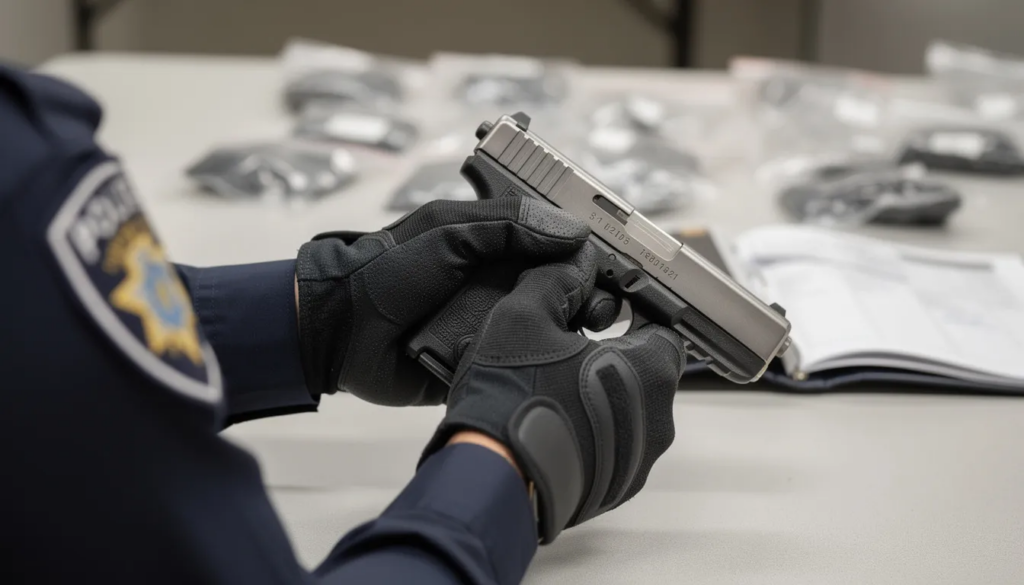
There is a legal difference between a temporary safety disarmament during a stop and a formal seizure of the gun as evidence or contraband. In my opinion, courts generally recognize that a temporary disarmament for officer safety does not amount to a full seizure, but the specifics can depend on the circumstances and jurisdiction. Understanding this distinction matters if you want your firearm returned.
Additionally, if an officer runs a serial number on a seized weapon that is in plain view, it does not constitute a ‘search’ under the Fourth Amendment.
Temporary Safety Disarmament
This is limited in time and purpose:
- The officer holds the gun only while the stop or investigation is ongoing
- The firearm is returned (usually unloaded) when the encounter ends
- No crime has been found, and there is no independent reason to keep it
Formal Seizure
A seizure typically involves:
- Tagging the firearm as evidence
- Booking it into a property room
- Using it to support charges such as misconduct involving weapons under A.R.S. § 13-3102, DUI with a weapon, or domestic violence offenses
Constitutional Protections
The Fourth Amendment protects against unreasonable search and seizure. Federal precedent requires reasonable suspicion or probable cause to convert a purely safety-based hold into an evidentiary seizure. Mere lawful possession is not, by itself, grounds to keep the gun.
If an officer extends the stop significantly to search for firearm-related violations without cause, or keeps a lawfully possessed gun without a valid legal basis, that conduct may be challengeable in Arizona courts. In Hernandez v. Arizona (2022), a trial court found that holding a firearm 45 minutes beyond the issuance of a citation violated the principle that stops must not be prolonged beyond their mission.
Do You Have to Tell an Arizona Officer You Are Armed?
Arizona does not impose the same affirmative duty to inform that exists in some other states. However, there are still important legal and practical expectations during encounters with police. It’s a good idea to remain calm and cooperative during a traffic stop, especially if you are carrying a firearm, as this can help de-escalate the situation and ensure a safer interaction for everyone involved.
The Legal Answer
- If an officer asks whether you are armed, you must answer truthfully
- Lying or attempting to conceal the presence of a firearm can escalate the encounter
- Dishonesty may affect your credibility if charges arise
Practical Recommendations
CCW training in Arizona typically encourages proactive, calm disclosure. A common approach:
“Officer, I want you to know I’m lawfully carrying a handgun. How would you like me to proceed?”
Additional tips:
- Keep your hands visible on the steering wheel
- Do not reach toward the weapon or glove box without explicit instruction
- Wait for clear commands about where to place your hands
- Communicate before making any movement inside the vehicle
Every encounter is different, and JacksonWhite cannot provide one-size-fits-all advice in an article. However, calm, respectful communication and compliance with lawful instructions generally reduce risk during armed encounters.
How and When Will Police Return Your Gun in Arizona?
What happened to your firearm—and when you get it back—depends on the circumstances of the stop and what the officers discovered.
If law enforcement decides not to return your firearm, you may pursue appeals through the court system to challenge that decision. In some cases, the court concluded that the firearm should be returned to its owner if there was no legal basis for its retention, while in others, the court concluded that law enforcement could retain the firearm under specific circumstances.
Return at the Roadside
When an officer takes a gun temporarily for safety during a minor traffic stop (speeding, lane-change violation) and no other issues arise, the officer usually returns the unloaded firearm at the roadside before the motorist leaves.
According to available data, approximately 65% of firearms taken during Arizona traffic stops are returned the same day.
Return From a Property Room
If the firearm is placed on an investigative hold or seized as evidence, it will typically be stored in a police or sheriff’s property room. To retrieve it, the owner may need to:
- Show valid identification
- Prove ownership (receipt, registration, or other documentation)
- Satisfy any legal requirements (no pending charges, not a prohibited possessor)
Factors That Can Prevent Return
| Factor | Explanation |
| Active criminal charges involving the weapon | The firearm may be held as evidence |
| Existing or newly issued protective orders | Possessing firearms may be prohibited |
| Prohibited possessor status (federal or state) | Return would be unlawful |
| Confirmed stolen status | The gun belongs to someone else |
If you are having trouble getting a firearm back from an Arizona agency, the JacksonWhite criminal defense team can help navigate property-release procedures or challenge unlawful retention in court.
What to Do If Your Gun Is Taken During a Traffic Stop or Investigation in Arizona
If officers take your firearm during an encounter, your actions during and after the stop can significantly affect your legal options.
During the Stop
- Remain calm. Do not argue on the roadside or attempt to physically interfere with an officer who is disarming you.
- Keep hands visible. Follow lawful commands about where to place your hands.
- Do not resist. Resisting can lead to charges under A.R.S. § 13-2508, regardless of whether the seizure was proper.
- Ask questions politely. You can ask why the firearm is being taken and whether you will receive documentation.
After the Encounter
Document the following details as soon as possible:
- Date and time of the stop
- Location (intersection, highway, mile marker)
- Agency involved (Phoenix PD, DPS, local city PD)
- Officer’s name or badge number if known
- Any property or incident numbers provided
Seek Clarification
Contact the agency to request clarification about the status of your firearm:
- Is it being held temporarily for safekeeping?
- Has it been logged as evidence?
- Is it on an investigative hold?
- What process or paperwork is required to seek its return?
Contact an Attorney
If you believe your rights were violated or your firearm is being improperly held, contact JacksonWhite’s Arizona criminal defense attorneys. We can review the facts, explain your options, and—where appropriate—pursue return of the gun or contest the legality of the seizure.
Frequently Asked Questions
Can police take a passenger’s gun during a traffic stop in Arizona?
Yes. If an officer has lawfully stopped a vehicle and reasonably believes a passenger’s firearm creates a safety risk, Arizona law allows temporary disarmament of passengers as well as drivers. The same rules apply: the firearm should be returned when the encounter ends if no crime is found. Passengers should follow the same safety practices—keep hands visible, answer firearm questions truthfully, and comply with lawful commands.
Can an officer run the serial number on my gun during a stop?
If an officer lawfully possesses your firearm during a stop, it is common for them to check the serial number against stolen-gun databases like NCIC. Courts often treat this as part of a safety and investigatory function if it does not unreasonably prolong the stop. However, removing grips or disassembling a gun to access a hidden serial number may raise additional Fourth Amendment concerns, and any significant delay or invasive inspection can potentially be challenged by an attorney.
What if I am from another state and my gun is taken in Arizona?
Out-of-state visitors are still subject to Arizona law during traffic stops. Officers may temporarily disarm or seize firearms on the same grounds as they would with Arizona residents. Getting a firearm back from an Arizona agency while living in another state can be more complicated and may require proof of lawful ownership and compliance with both states’ laws. Consulting an Arizona criminal defense lawyer is particularly important in this situation.
Can I record my traffic stop if I have a gun in the car?
In general, individuals in Arizona may record police in public places as long as they do not interfere with the officer’s duties or ignore lawful commands. Calmly recording from a safe distance or a fixed position is usually permitted. However, reaching for a phone suddenly—especially if an officer already knows there is a gun in the vehicle—can be misinterpreted. Tell the officer what you are doing before moving your hands.
What if the officer never gives me a receipt or property form for my gun?
If a firearm is kept beyond the stop for evidence or an investigative hold, agencies typically generate an incident or property number. Owners can later request information using that number or their own identifying details. If no documentation is provided and you cannot get clear answers from the agency, contact a criminal defense attorney promptly to help track the firearm and assert your rights.
When to Call the JacksonWhite Criminal Defense Team
Firearm laws, investigative holds, and constitutional issues can be complex and fact-specific. Anyone facing more than a routine, short-term safety disarmament should consider speaking with an attorney.
JacksonWhite’s criminal defense team is based in Arizona and familiar with local courts, prosecutors, and law enforcement agencies throughout Maricopa County and surrounding areas. This local knowledge can be critical when negotiating property returns or challenging seizures.
If you have questions about a traffic stop, an investigative hold, or how to recover your firearm, contact the JacksonWhite criminal defense team today at (480) 745-1639 to schedule a confidential consultation. Getting personalized legal advice—rather than relying solely on general online information—is the best way to protect your rights.